Introduction
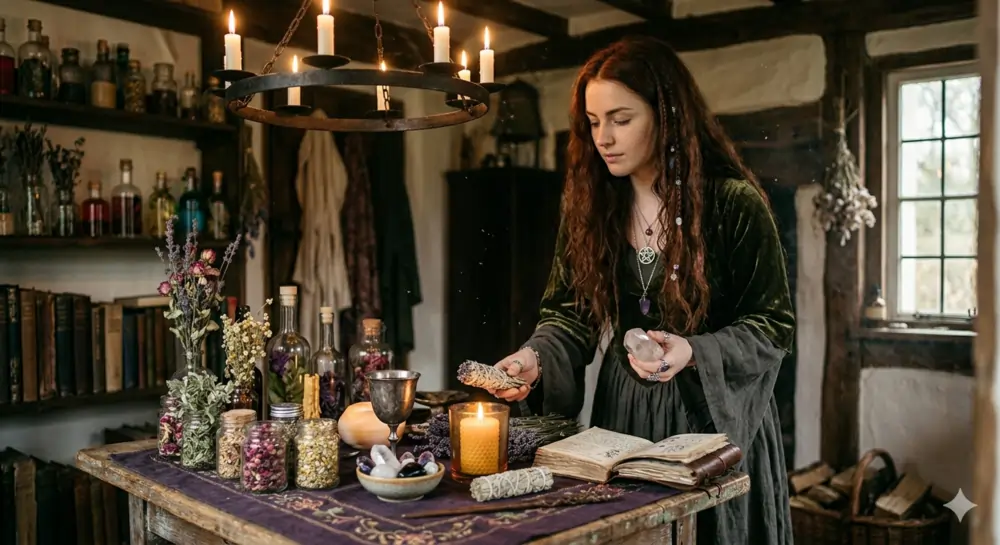
Since ancient times, altars have played a central role in spiritual, magical, and religious practices. They serve as a bridge between the physical world and the unseen realms. Whether dedicated to meditation, magic, divination, ancestral veneration, or a specific deity, an altar creates a sacred space where energy can be focused and directed.
Creating an altar involves much more than simply arranging a few objects on a table. It is a symbolic act that establishes a deeper connection with your spiritual path. Before using an altar or the tools placed upon it, however, it is important to cleanse and consecrate them to remove unwanted energies and align them with your intentions.
In this article, we will explore how to create an effective altar, the essential tools it should contain, various methods of purification, and the process of consecrating both the altar and its sacred instruments.
Why Create an Altar?
An altar serves as a personal spiritual center. It acts as a focal point for prayers, meditation, magical workings, manifestations, and spiritual growth.
Some of the main purposes of an altar include:
- Enhancing spiritual focus and concentration.
- Creating a sacred space within your home.
- Honoring deities, spirit guides, or ancestors.
- Supporting rituals and ceremonial work.
- Strengthening intentions and energy work.
- Providing a dedicated place for reflection and inner connection.
Even a small altar can become a powerful spiritual tool when maintained with care and intention.
Choosing the Ideal Location
The location of your altar can significantly influence your practice.
Factors to Consider
Choose a space that is:
- Quiet and peaceful.
- Free from frequent disturbances.
- Clean and organized.
- Comfortable and energetically uplifting.
Popular locations include:
- A dedicated spiritual room.
- A corner of a bedroom.
- A home office.
- A meditation space.
- A secluded outdoor area or garden.
The most important factor is selecting a place where you feel calm, inspired, and spiritually connected.
Different Types of Altars
Spiritual Altar
Designed for meditation, prayer, and spiritual connection.
Common items include:
- Candles
- Incense
- Crystals
- Sacred symbols
- Inspirational objects
Ancestor Altar
Dedicated to honoring deceased family members and ancestors.
It may contain:
- Photographs
- Family heirlooms
- Written messages
- Offerings of food or drink
- White candles
Ancestor altars are commonly used to strengthen ancestral bonds and express gratitude.
Magical Altar
Used for ritual work, spellcraft, and ceremonial practices.
Common tools include:
- Ritual implements
- Candles
- Pentacles
- Herbs
- Crystals
- Sacred texts
Seasonal Altar
Created to celebrate natural cycles and seasonal festivals.
Decorations may change according to:
- The seasons
- Lunar phases
- Solstices and equinoxes
- Personal spiritual celebrations
Seasonal altars help practitioners align with the rhythms of nature.
Essential Altar Tools
Candles
Candles represent the element of Fire.
They symbolize:
- Transformation
- Passion
- Spiritual illumination
- Divine presence
Common Candle Color Meanings
- White: Purification, protection, spirituality.
- Red: Strength, courage, passion.
- Green: Prosperity, abundance, growth.
- Blue: Peace, healing, intuition.
- Purple: Wisdom, psychic development.
- Black: Protection, banishing negativity.
Crystals
Crystals are often used to amplify and direct spiritual energy.
Clear Quartz
Known as the "Master Healer."
Benefits include:
- Energy amplification
- Mental clarity
- Spiritual enhancement
Amethyst
Associated with:
- Spiritual awareness
- Meditation
- Psychic protection
- Inner peace
Rose Quartz
Represents:
- Love
- Compassion
- Emotional healing
- Harmony
Obsidian
Often used for:
- Protection
- Grounding
- Energy shielding
- Shadow work
Incense
Incense has been used for thousands of years to cleanse spaces and elevate spiritual vibrations.
Popular varieties include:
- Frankincense
- Myrrh
- Sandalwood
- Benzoin
- Sage
- Palo Santo
The rising smoke symbolizes prayers and intentions ascending to higher realms.
Water Bowl
A bowl of water represents the element of Water.
It symbolizes:
- Intuition
- Emotions
- Healing
- Spiritual purification
Some practitioners enhance the bowl with:
- Sea salt
- Flower petals
- Moon water
- Safe crystals
Salt
Salt is one of humanity's oldest purification tools.
It is commonly used for:
- Protection
- Cleansing
- Energy purification
- Creating sacred boundaries
Many traditions view salt as a powerful barrier against negative influences.
Athame or Ritual Knife
An athame is a ceremonial blade used to direct energy.
Its primary functions include:
- Casting sacred circles
- Directing spiritual energy
- Symbolic ritual work
- Consecrating objects
Traditionally, it is not used for physical cutting.
Chalice
The chalice symbolizes receptivity and abundance.
It is associated with:
- The element of Water
- The Divine Feminine
- Fertility
- Spiritual nourishment
A chalice often holds blessed water, wine, or ritual offerings.
Pentacle
A pentacle is a sacred disk bearing spiritual symbols, often a pentagram.
It serves as:
- An energy anchor
- A protective symbol
- A surface for charging magical tools
- A representation of Earth energy
Why Purify Spiritual Tools?
Every object absorbs energy from its environment.
During manufacturing, shipping, handling, and storage, spiritual tools can accumulate various energetic imprints.
Purification helps to:
- Remove residual energies.
- Clear previous influences.
- Restore energetic neutrality.
- Prepare tools for personal spiritual use.
Many practitioners purify new tools immediately after acquiring them.
Methods of Purification
Smoke Cleansing
One of the most common methods.
You can use:
- Frankincense
- Myrrh
- Sage
- Palo Santo
- Sandalwood
Pass each object slowly through the smoke while focusing on the intention of cleansing.
Salt Purification
Place an object in or near a bowl of salt for several hours.
Important:
Not all crystals tolerate direct contact with salt. Research each stone before using this method.
Water Cleansing
Water has long been associated with purification and renewal.
Suitable objects may be rinsed under clean running water.
However, some crystals should never be submerged, including:
- Selenite
- Malachite
- Pyrite
- Lepidolite
Always verify whether a crystal is water-safe.
Moonlight Cleansing
Moonlight is one of the gentlest and most popular cleansing methods.
Place tools:
- On a windowsill
- In a garden
- Under the full moon
Many practitioners prefer the Full Moon because it is traditionally associated with heightened spiritual energy.
Sound Cleansing
Sound vibrations can break up stagnant energy and restore harmony.
Common tools include:
- Singing bowls
- Bells
- Chimes
- Tuning forks
- Sacred chants and mantras
The vibrations help cleanse both objects and spaces.
How to Consecrate Spiritual Tools
Once an object has been purified, it can be consecrated.
Consecration dedicates the tool to your spiritual practice and aligns it with your intentions.
Preparation
Gather:
- A white candle
- Incense
- The purified tool
Take a few moments to center yourself through meditation or deep breathing.
Simple Consecration Ritual
Hold the object gently in your hands.
Visualize a bright white or golden light surrounding and filling it.
Then say:
"I consecrate this tool to my spiritual path. May it be purified, protected, and aligned with my highest intentions. May it serve the light and support my spiritual growth."
Remain still for a few moments while focusing on the energy flowing into the object.
The tool is now consecrated.
Consecrating the Altar Itself
Once all tools have been arranged, you may consecrate the altar as a whole.
Step 1: Light a Candle
Invite the energy of Fire.
Step 2: Burn Incense
Invite the energy of Air.
Step 3: Sprinkle Water
Invite the energy of Water.
Step 4: Add Salt
Invite the energy of Earth.
These four elements symbolize balance and harmony.
Then say:
"I consecrate this altar as a sacred space. May it be protected, purified, and dedicated to spiritual growth, wisdom, and positive energy."
Visualize a sphere of radiant light surrounding the altar and filling the room.
Maintaining Your Altar
A spiritual altar benefits from regular care and attention.
Helpful maintenance practices include:
- Dusting sacred objects.
- Replacing burned candles.
- Cleansing crystals regularly.
- Refreshing offerings.
- Rearranging items as your practice evolves.
- Spending a few moments at the altar each day.
The more intentionally you interact with your altar, the stronger its symbolic and spiritual significance becomes.
Conclusion
Creating an altar is a meaningful way to deepen your spiritual practice and establish a sacred connection within your daily life. Whether simple or elaborate, an altar becomes a powerful focal point for meditation, ritual work, prayer, and personal transformation.
By carefully selecting your tools, regularly cleansing them, and consecrating both the objects and the altar itself, you create a space infused with purpose and intention. Ultimately, the true power of an altar does not come from the objects it contains but from the energy, dedication, and spiritual focus you bring to it.
Your altar is a reflection of your spiritual journey—a sacred space that evolves alongside you as you continue to grow and explore the mysteries of the unseen world.
Gemini, CC0,
